|
|
| Line 1: |
Line 1: |
| − | ==PFAS Transport and Fate== | + | ==PFAS Leaching Characterization with the Leaching Environmental Assessment Framework (LEAF)== |
| − | The transport and fate of Per- and Polyfluoroalkyl Substances (PFAS) in the environment is controlled by the nature of the PFAS source, characteristics of the individual PFAS, and environmental conditions where the PFAS are present. Transport, partitioning, and transformation are the primary processes controlling PFAS fate in the environment. PFAS compounds can also be taken up by both plants and animals, and in some cases, bioaccumulate through the food chain.
| + | [[Wikipedia: Firefighting_foam#Synthetic_foams | Aqueous film-forming foams (AFFFs)]] are a major source of [[Perfluoroalkyl and Polyfluoroalkyl Substances (PFAS) | per- and poly-fluoroalkyl substances (PFAS)]] impacts in soil and groundwater. Standardized tools are needed to rapidly assess the potential for retention, leaching, and transport of PFAS from the source zone to downgradient regions, so that this information can be applied towards critical facets of site management such as prioritizing PFAS-impacted sites for further investigation and remediation. Existing standard leaching methods were developed prior to concerns regarding PFAS. Therefore, studies are needed to ensure that leaching methods are compatible for use with PFAS and that resulting data are representative of the risk of PFAS leaching at impacted sites. |
| − | Understanding PFAS transport and fate is necessary for evaluating the potential risk from a PFAS release and for predictions about PFAS occurrence, migration, and persistence, and about the potential vectors for exposure. This knowledge is important for site characterization, identification of potential sources of PFAS to the site, development of an appropriate conceptual site model (CSM), and selection and predicted performance of remediation strategies.
| |
| − | | |
| | <div style="float:right;margin:0 0 2em 2em;">__TOC__</div> | | <div style="float:right;margin:0 0 2em 2em;">__TOC__</div> |
| | | | |
| − | '''Related Article(s): ''' | + | '''Related Article(s):''' |
| − | * [[Perfluoroalkyl and Polyfluoroalkyl Substances (PFAS)]]
| |
| − | | |
| − | '''Contributor(s): '''
| |
| − | Dr. Hunter Anderson and Dr. Mark L. Brusseau
| |
| | | | |
| − | '''Key Resource(s): '''
| + | *[[Perfluoroalkyl and Polyfluoroalkyl Substances (PFAS)]] |
| − | *[https://pfas-1.itrcweb.org/wp-content/uploads/2020/04/ITRC_PFAS_TechReg_April2020.pdf Per- and Polyfluoroalkyl Substances (PFAS), PFAS-1. ITRC 2020.]<ref name="ITRC2020">Interstate Technology and Regulatory Council (ITRC), 2020. Technical/Regulatory Guidance: Per- and Polyfluoroalkyl Substances (PFAS), PFAS-1. ITRC, PFAS Team, Washington DC. [https://pfas-1.itrcweb.org/wp-content/uploads/2020/04/ITRC_PFAS_TechReg_April2020.pdf Free Download from ITRC]. [[Media: ITRC_PFAS-1.pdf | Report.pdf]]</ref> | + | *[[PFAS Sources]] |
| | + | *[[PFAS Transport and Fate]] |
| | | | |
| − | *[[Media: Brusseau2018manuscript.pdf | Assessing the Potential Contributions of Additional Retention Processes to PFAS Retardation in the Subsurface. Brusseau 2018 (manuscript).]]<ref name="Brusseau2018">Brusseau, M.L., 2018. Assessing the Potential Contributions of Additional Retention Processes to PFAS Retardation in the Subsurface. Science of the Total Environment, 613-614, pp. 176-185. [https://doi.org/10.1016/j.scitotenv.2017.09.065 DOI: 10.1016/j.scitotenv.2017.09.065] [[Media: Brusseau2018manuscript.pdf | Author’s Manuscript]]</ref>
| + | '''Contributors:''' Dr. Jennifer L. Guelfo, Dr. David Kosson, Dr. Andy Garrabrants, Ms. Fangfei Liu, Mr. Darlington Yawson, Dr. Md. Isreq Real |
| | | | |
| − | ==Introduction==
| + | '''Key Resources:''' |
| − | The transport and fate of [[Perfluoroalkyl and Polyfluoroalkyl Substances (PFAS)]] is a rapidly evolving field of science, with many questions that are not yet resolved. Much of the currently available information is based on a few well-studied PFAS compounds. However, there is a large number and variety of PFAS with a wide range of physical and chemical characteristics that affect their behavior in the environment. The transport and fate of some PFAS could differ significantly from the compounds studied to date. Nevertheless, information about the behavior of some PFAS in the environment can be ascertained from the results of currently available research.
| + | *Development of Leaching Tests for Materials Containing SVOCs and PFAS, EPA 600/R-23/382<ref name="GarrabrantsEtAl2024"/> |
| | | | |
| − | PFAS transport and fate in the environment is controlled by the nature of the PFAS source, characteristics of the individual PFAS, and environmental conditions where the PFAS are present. Perfluoroalkyl acids (PFAAs) (see [[Perfluoroalkyl and Polyfluoroalkyl Substances (PFAS) | PFAS]] for nomenclature) are strong acids and are anionic in the environmentally-relevant pH range. They are extremely persistent in the environment and do not degrade or transform under typical environmental conditions. Polyfluoroalkyl substances (see [[Perfluoroalkyl and Polyfluoroalkyl Substances (PFAS) | PFAS]] for nomenclature) include compounds that have the potential to degrade to PFAAs. These compounds are commonly referred to as PFAA precursors or just ‘precursors’. Because some polyfluoroalkyl substances can degrade into PFAA via biotic or abiotic degradation pathways, PFAAs are sometimes referred to as “terminal PFAS” or “terminal degradation products”.
| + | *[https://www.epa.gov/hw-sw846/leaching-environmental-assessment-framework-leaf-methods-and-guidance Leaching Environmental Assessment Framework (LEAF) Methods and Guidance] (EPA website) |
| − | The most important molecular properties controlling PFAA transport are the carbon chain length and functional moieties of the headgroups (e.g., sulfonate, carboxylate). The molecular properties of PFAA precursors are more varied, with different carbon chain lengths, headgroups and ionic states<ref name="Buck2011">Buck, R.C., Franklin, J., Berger, U., Conder, J.M., Cousins, I.T., de Voogt, P., Jensen, A.A., Kannan, K., Mabury, S.A., and van Leeuwen, S.P.J., 2011. Perfluoroalkyl and Polyfluoroalkyl Substances in the Environment: Terminology, Classification, and Origins. Integrated Environmental Assessment and Management, 7(4): pp. 513-541. [ https://doi.org/10.1002/ieam.258 DOI: 10.1002/ieam.258] [https://setac.onlinelibrary.wiley.com/doi/epdf/10.1002/ieam.258 Open Access Article]</ref><ref name="Wang2017">Wang, Z., DeWitt, J.C., Higgins, C.P., and Cousins, I.T., 2017. A Never-Ending Story of Per- and Polyfluoroalkyl Substances (PFASs)? Environmental Science and Technology, 51(5), pp. 2508-2518. American Chemical Society. [https://doi.org/10.1021/acs.est.6b04806 DOI: 10.1021/acs.est.6b04806] [https://pubs.acs.org/doi/pdf/10.1021/acs.est.6b04806 Free Download from ACS]</ref> (see [[Perfluoroalkyl and Polyfluoroalkyl Substances (PFAS) | PFAS]]). All of these properties can influence transport and fate of PFAA precursors in the environment.
| |
| | | | |
| − | Important environmental characteristics include the nature of the source (mode of input into the environment), the length of time that the source was active, and the magnitude of the input, as well as precipitation and infiltration rates, depth to groundwater, surface water and groundwater flow rates and interactions, prevailing atmospheric conditions, the properties of the porous-media (e.g., soil and sediment) and aqueous solution, microbiological factors, and the presence of additional fluid phases such as air and non-aqueous phase liquids [[Wikipedia: Non-aqueous phase liquid | (NAPLs)]] in the vadose zone and water-saturated source. In the subsurface, soil characteristics (texture, organic carbon content, clay mineralogy, metal-oxide content, solid surface area, surface charge, and exchange capacity) and solution characteristics (pH, redox potential, major ion chemistry, and co-contaminants) can influence PFAS transport and fate.
| + | ==Introduction to LEAF== |
| | + | The [https://www.epa.gov/ U.S. Environmental Protection Agency (EPA)] [https://www.epa.gov/hw-sw846/leaching-environmental-assessment-framework-leaf-methods-and-guidance Leaching Environmental Assessment Framework (LEAF)] is a suite of standardized test methods for evaluating contaminant release from solids under environmentally relevant conditions (Table 1). The four leaching methods within LEAF were originally validated for inorganic constituents<ref>Garrabrants, A.C., Kosson, D.S., Stefanski, L., DeLapp, R., Seignette, P.F.A.B., van der Sloot, H.A., Kariher, P., Baldwin, M., 2012. Interlaboratory Validation of the Leaching Environmental Assessment Framework (LEAF) Method 1313 and Method 1316, EPA/600/R-12/623, U.S. Environmental Protection Agency, Air Pollution and Control Division. [[Media: EPA 600_R-12_623.pdf | Free Download EPA 600/R-12/623]]</ref><ref>Garrabrants, A.C., Kosson, D.S., DeLapp, R., Kariher, P., Seignette, P.F.A.B., van der Sloot, H.A., Stefanski, L., Baldwin, M., 2012. Interlaboratory Validation of the Leaching Environmental Assessment Framework (LEAF) Method 1314 and Method 1315, EPA/600/R-12/624, U.S. Environmental Protection Agency, Air Pollution and Control Division. [[Media: EPA 600_R-12_624.pdf | Free Download EPA 600/R-12/624]]</ref> and included as standard leaching methods EPA 1313 – 1316 within Update V of SW-846<ref>USEPA, 2026. Hazardous Waste Test Methods / SW-846. [https://www.epa.gov/hw-sw846 USEPA SW-846 website]</ref>. To address the need for standardized tests to evaluate PFAS leaching and mobility, LEAF methods have been optimized and demonstrated for use with PFAS (Methods 1313A-1316A)<ref name="GarrabrantsEtAl2024">Garrabrants, A.C., Liu, F., Warne, R., DeLapp, R., Brown, L., Rubin, Z., Yawson, D., Kosson, D.S., Guelfo, J.L., Real, M.I., van der Sloot, H.A., Touati, A., Thorneloe, S., 2024. Development of Leaching Tests for Materials Containing SVOCs and PFAS, EPA 600/R-23/382, USEPA, Washington, D.C. [[Media: EPA 600_R-23_382.PDF | Free Download EPA 600/R-23/382]]</ref>. This article will focus on Methods 1313A, 1314A, and 1316A. Demonstration of Method 1315A for compacted granular materials (including concrete and asphalt) is ongoing. |
| | | | |
| − | ==PFAS Transport and Fate Processes== | + | {| class="wikitable" style="float:right; margin-left:10px;" |
| − | [[File:AndersonBrusseau1w2Fig1.png | thumb | 600px | Figure 1. Illustration of PFAS partitioning and transformation processes. Source: D. Adamson, GSI, used with permission.]]
| + | |+Table 1. EPA SW-846 methods that comprise the LEAF framework |
| − | Transport, partitioning, and transformation are the primary processes controlling PFAS fate in the environment (Figure 1). PFAS compounds can also be taken up by both plants and animals, and in some cases, bioaccumulate through the food chain. However, PFAS uptake and bioaccumulation is not discussed in this article (see “Environmental Concern” section of [[Perfluoroalkyl and Polyfluoroalkyl Substances (PFAS)]]).
| + | |- |
| | + | !Method |
| | + | !Description |
| | + | |- |
| | + | | 1313 || Liquid-solid partitioning as a function of '''''extract pH''''' using a parallel batch extraction (i.e., equilibrium) procedure (Figure 1) |
| | + | |- |
| | + | | 1314 || Liquid-solid partitioning as a function of '''''liquid-solid ratio (L/S)''''' for constituents in solid materials using an up-flow '''''percolation''''' column procedure (Figure 3) |
| | + | |- |
| | + | | 1315 || '''''Mass transfer rates''''' of constituents in monolithic or compacted granular materials using a semi-dynamic tank leaching procedure |
| | + | |- |
| | + | | 1316 || Liquid-solid partitioning as a function of '''''L/S''''' using a parallel batch extraction (i.e., '''''equilibrium''''') procedure (Figure 2) |
| | + | |- |
| | + | | colspan="2" style="background:white;" | Note: Text shown in '''''bold''''' indicates primary condition evaluated in each method. |
| | + | |} |
| | | | |
| − | * '''Transport:''' PFAS can be transported substantial distances in the atmosphere<ref name="Ahrens2012">Ahrens, L., Harner, T., Shoeib, M., Lane, D.A. and Murphy, J.G., 2012. Improved Characterization of Gas–Particle Partitioning for Per- and Polyfluoroalkyl Substances in the Atmosphere Using Annular Diffusion Denuder Samplers. Environmental Science and Technology, 46(13), pp. 7199-7206. [https://doi.org/10.1021/es300898s DOI: 10.1021/es300898s] Free download available from [https://www.researchgate.net/profile/Tom_Harner/publication/225046057_Improved_Characterization_of_Gas-Particle_Partitioning_for_Per-_and_Polyfluoroalkyl_Substances_in_the_Atmosphere_Using_Annular_Diffusion_Denuder_Samplers/links/5cc730c4299bf12097893fdc/Improved-Characterization-of-Gas-Particle-Partitioning-for-Per-and-Polyfluoroalkyl-Substances-in-the-Atmosphere-Using-Annular-Diffusion-Denuder-Samplers.pdf ResearchGate].</ref>, surface water<ref name="Taniyasu2013">Taniyasu, S., Yamashita, N., Moon, H.B., Kwok, K.Y., Lam, P.K., Horii, Y., Petrick, G. and Kannan, K., 2013. Does wet precipitation represent local and regional atmospheric transportation by perfluorinated alkyl substances? Environment International, 55, pp. 25-32. [https://doi.org/10.1016/j.envint.2013.02.005 DOI: 10.1016/j.envint.2013.02.005]</ref>, soil<ref name="Braunig2017">Bräunig, J., Baduel, C., Heffernan, A., Rotander, A., Donaldson, E. and Mueller, J.F., 2017. Fate and redistribution of perfluoroalkyl acids through AFFF-impacted groundwater. Science of the Total Environment, 596, pp. 360-368. [https://doi.org/10.1016/j.scitotenv.2017.04.095 DOI: 10.1016/j.scitotenv.2017.04.095]</ref>, and groundwater<ref name="Weber2017">Weber, A.K., Barber, L.B., LeBlanc, D.R., Sunderland, E.M. and Vecitis, C.D., 2017. Geochemical and Hydrologic Factors Controlling Subsurface Transport of Poly- and Perfluoroalkyl Substances, Cape Cod, Massachusetts. Environmental Science and Technology, 51(8), pp. 4269-4279. [https://doi.org/10.1021/acs.est.6b05573 DOI: 10.1021/acs.est.6b05573] [https://bgc.seas.harvard.edu/assets/weber2017_final.pdf Free Download]</ref>. The primary mechanisms controlling PFAS transport are [[Wikipedia:Advection | advection]] and [[Wikipedia:Dispersive_mass_transfer | dispersion]], similar to other dissolved compounds. For additional information on transport in groundwater, see [[Advection and Groundwater Flow]] and [[Dispersion and Diffusion]].
| + | ==Method Development for PFAS== |
| | + | Complete details of the development of LEAF Methods 1313A, 1314A, and 1316A for use with PFAS are available in Garrabrants ''et al.'', 2024<ref name="GarrabrantsEtAl2024"/>. Representative method modifications include: |
| | + | * Materials of construction for experimental apparatus: containers used for leaching vessels (Methods 1313A, 1316A) and column construction materials (Method 1314A) evaluated for background PFAS and PFAS uptake. |
| | + | * Reagents and eluant composition: eluant composition was optimized to use 1 mM CaCl2 to reduce formation of colloidal matter; Method 1313A pH adjustment now conducted with nonoxidizing HCl. |
| | + | * Experimental conditions: Longer equilibration times (e.g., Method 1313, 1316) may be required due to slow desorption kinetics of certain PFAS from soil and organic matrices, implementation of settling to facilitate separation of solids from eluates. |
| | + | * Eluate processing (all methods): Use of centrifugation in lieu of eluate filtering, sonication of bottle prior to eluate subsampling. |
| | | | |
| − | * '''Partitioning:''' Partitioning of PFAS between the mobile and immobile phases is one of the most important processes controlling the rate of migration in the environment. The primary mobile phases are typically air and water. Relatively immobile phases include stream sediments, soils, aquifer material, NAPLs, and interfaces between different phases (air-water, NAPL-water). Partitioning of a significant portion of the PFAS mass into an immobile phase increases the amount of material stored in the system and slows the apparent rate of migration in the mobile phase – a phenomenon that has been observed in field metadata<ref name="Anderson2019">Anderson, R.H., Adamson, D.T. and Stroo, H.F., 2019. Partitioning of poly-and perfluoroalkyl substances from soil to groundwater within aqueous film-forming foam source zones. Journal of Contaminant Hydrology, 220, pp. 59-65. [https://doi.org/10.1016/j.jconhyd.2018.11.011 DOI: 10.1016/j.jconhyd.2018.11.011] Manuscript available from [https://www.researchgate.net/profile/Hans_Stroo3/publication/329227107_Partitioning_of_poly-_and_perfluoroalkyl_substances_from_soil_to_groundwater_WITHIN_aqueous_film-forming_foam_source_zones/links/5e56996b299bf1bdb83e2f69/Partitioning-of-poly-and-perfluoroalkyl-substances-from-soil-to-groundwater-WITHIN-aqueous-film-forming-foam-source-zones.pdf ResearchGate]</ref>.
| + | ==Batch Test Demonstration Studies== |
| | + | PFAS-specific adaptations were tested in batch test demonstration studies, which included triplicate implementation of Methods 1313A and 1316A in four AFFF-impacted site soils. |
| | | | |
| − | * '''Transformation:''' Transformation of PFAS is controlled by the molecular structure of the individual compounds. Perfluorinated compounds, including PFAAs, are resistant to abiotic and biotic transformation reactions under typical conditions and highly persistent in the environment. In contrast, precursors can be transformed by both abiotic and biotic processes, often resulting in the production of so-called “terminal” PFAA daughter products.
| + | [[File: GuelfoFig1.png | thumb | 500 px | Figure 1: Figure 1. a) Overview of LEAF Method 1313A and b) PFHxS leaching as a function of pH<ref name="GarrabrantsEtAl2024"/>. Definitions: lower limit of quantification (LLOQ) and method detection limit (MDL)]] |
| | + | '''Draft Method 1313A''' was used to evaluate pH-dependent leaching in PFAS-contaminated soils in parallel batch extractions where each set of batch reactors is prepared and equilibrated at different pH (Figure 1). Short-chain PFAS (≤6 fluorinated carbons) generally showed little to no variation in leaching across the tested pH range of 2-13 (e.g., [[Wikipedia: Perfluorohexanesulfonic acid | PFHxS]], Figure 1), whereas long-chain PFAS exhibited increased leaching at higher pH<ref name="GarrabrantsEtAl2024"/>. This trend is consistent with previous findings showing that soil-water partitioning coefficients (''K<sub>d</sub>'') decrease as pH increases (e.g., Higgins and Luthy 2006)<ref name="HigginsLuthy2006">Higgins, C.P., Luthy, R.G., 2006. Sorption of Perfluorinated Surfactants on Sediments. Environmental Science and Technology, 40(23), pp. 7251–7256. [https://doi.org/10.1021/es061000n doi: 10.1021/es061000n]</ref>. The most pronounced pH effects were observed for perfluoroalkyl sulfonamides (FASAs) such as [[Wikipedia: Perfluorooctanesulfonamide | perfluorooctane sulfonamide (FOSA)]], which transition from neutral to anionic forms within the circumneutral pH range (~pH 6). The anionic form has a lower ''K<sub>d</sub>'' and results in higher leaching concentrations<ref name="GarrabrantsEtAl2024"/><ref name="NguyenEtAl2020">Nguyen, T.M.H., Bräunig, J., Thompson, K., Thompson, J., Kabiri, S., Navarro, D.A., Kookana, R.S., Grimison, C., Barnes, C.M., Higgins, C.P., McLaughlin, M.J., Mueller, J.F., 2020. Influences of Chemical Properties, Soil Properties, and Solution pH on Soil–Water Partitioning Coefficients of Per- and Polyfluoroalkyl Substances (PFASs). Environmental Science and Technology, 54(24), pp. 15883–15892. [https://doi.org/10.1021/acs.est.0c05705 doi: 10.1021/acs.est.0c05705] [[Media: NguyenEtAl2020.pdf | Open Access Article]]</ref>. For many site management scenarios where pH is circumneutral, variations in anionic PFAS leaching are expected to be small over the relevant pH range. In such cases, when testing time and costs are primary considerations, Method 1313A may be a lower priority relative to evaluating leaching as a function of L/S (Method 1316A, Method 1314A). Different considerations may be needed where FASAs or PFAS with multiple, ionizable functional groups (i.e., [[Wikipedia: Zwitterion | zwitterions]]) are of concern. |
| | | | |
| − | ==Transport and Partitioning in the Atmosphere==
| + | [[File: GuelfoFig2.png | thumb | 500 px | Figure 2: a) Overview of LEAF Method 1316A and b) PFHxS leaching as a function of L/S ratio evaluated in parallel batch leaching vessels<ref name="GarrabrantsEtAl2024"/>]] |
| − | Air serves as a transport media for PFAS, particularly for uncharged polyfluorinated PFAS. Airborne PFAS transport contributes to global distribution and can lead to localized deposition to soils and surface water in the vicinity of emission sources<ref name="Simcik2005">Simcik, M.F. and Dorweiler, K.J., 2005. Ratio of Perfluorochemical Concentrations as a Tracer of Atmospheric Deposition to Surface Waters. Environmental Science and Technology, 39(22), pp. 8678-8683. [https://doi.org/10.1021/es0511218 DOI: 10.1021/es0511218] Free download available from [https://www.researchgate.net/profile/Matt_Simcik/publication/7444956_Ratio_of_Perfluorochemical_Concentrations_as_a_Tracer_of_Atmospheric_Deposition_to_Surface_Waters/links/5f035861299bf1881603c3be/Ratio-of-Perfluorochemical-Concentrations-as-a-Tracer-of-Atmospheric-Deposition-to-Surface-Waters.pdf ResearchGate]</ref><ref name="Prevedouros2006">Prevedouros, K., Cousins, I.T., Buck, R.C. and Korzeniowski, S.H., 2006. Sources, Fate and Transport of Perfluorocarboxylates. Environmental Science and Technology, 40(1), pp. 32-44. [https://doi.org/10.1021/es0512475 DOI: 10.1021/es0512475] Free download available from [https://d1wqtxts1xzle7.cloudfront.net/39945519/Sources_Fate_and_Transport_of_Perfluoroc20151112-1647-19vcvbf.pdf?1447365456=&response-content-disposition=inline%3B+filename%3DSources_Fate_and_Transport_of_Perfluoroc.pdf&Expires=1605023809&Signature=Z6KqgaDN6lKdAazoe6qoASoCtVystG5i~5EnrTcb~qMg3xZPz4O49Kghh62WmMzqEKE788~6EwrnlBVo9o6cM0hjf2vymFYxg4mx-eSIOEonfFjk6RonSaWp5gRbA6m~SNjwsjaKXID3OQyWIlLVpUd2LzAdI5rLGFA~gIXXtNPyCArLuGn-kbPYUIcBUg5TIkTZ6TDLXF~ujmzK9tNv~55UYabsJL4pmwIGC2sNGkEyJrYMfU577fbactdrmQXTJH7XbgpfDSfd4-xWkDZTdvVf~TypDDqUCZdtCkY8wINdpqtfe1KEzLrAj7rxxALAHUYxlVbPB45XTkLAGe5qww__&Key-Pair-Id=APKAJLOHF5GGSLRBV4ZA Academia]</ref><ref name="Ahrens2011">Ahrens, L., Shoeib, M., Harner, T., Lane, D.A., Guo, R. and Reiner, E.J., 2011. Comparison of Annular Diffusion Denuder and High Volume Air Samplers for Measuring Per- and Polyfluoroalkyl Substances in the Atmosphere." Analytical Chemistry, 83(24), pp. 9622-9628. [https://doi.org/10.1021/ac202414w DOI: 10.1021/ac202414w] Free download available from [https://www.informea.org/sites/default/files/imported-documents/UNEP-POPS-POPRC11FU-SUBM-PFOA-Canada-2-20151211.En.pdf Informea].</ref><ref name="Rauert2018">Rauert, C., Shoieb, M., Schuster, J.K., Eng, A. and Harner, T., 2018. Atmospheric concentrations and trends of poly-and perfluoroalkyl substances (PFAS) and volatile methyl siloxanes (VMS) over 7 years of sampling in the Global Atmospheric Passive Sampling (GAPS) network. Environmental Pollution, 238, pp. 94-102. [https://doi.org/10.1016/j.envpol.2018.03.017 DOI: 10.1016/j.envpol.2018.03.017] Open access article available from [https://reader.elsevier.com/reader/sd/pii/S0269749117352521?token=4C770E6E8AEDB0B3BA6A1D5B2C20ED5385F81823612551FA3380AAA1DA7A978F9CB36834AF6B7F91F35FF57E32013252 ScienceDirect] [[Media:Rauert2018.pdf | Report.pdf]]</ref>.
| + | '''Draft Method 1316A''' was used to evaluate L/S-dependent leaching of PFAS in impacted soils using parallel batch extractions where each set of batch reactors is prepared and equilibrated at a different L/S. (Figure 2). Methods 1314A and 1316A are similar in intent as they both evaluate leaching as a function of L/S; however, the experimental approach differs. Method 1314A uses a flow-through column configuration (Figure 3; discussed further below). Method 1314A may better simulate field conditions, but Method 1316A is simpler and less costly to implement. Trends in Method 1314A and 1316A are expected to be qualitatively similar but leaching concentrations are expected to exhibit differences. Despite this, leaching studies comparing Methods 1314A and 1316A for inorganics showed that cumulative release results were within one order of magnitude<ref>Lopez Meza, S., Garrabrants, A.C., van der Sloot, H., Kosson, D.S., 2008. Comparison of the Release of Constituents from Granular Materials under Batch and Column Testing. Waste Management, 28(10), pp. 1853–1867. [https://doi.org/10.1016/j.wasman.2007.11.009 doi: 10.1016/j.wasman.2007.11.009]</ref>. |
| | | | |
| − | PFAAs, which are ionic and possess a negative charge under ambient environmental conditions, are far less volatile than many other groundwater contaminants. An online database of vapor pressures and Henry’s Law constants for different PFAS, including PFAAs, is maintained by the Interstate Technology Regulatory Council<ref name="ITRC2020"/>. In general, vapor pressures of PFAS are low and water solubilities are high, limiting partitioning from water to air<ref name="ITRC2020"/>. However, under certain conditions, particularly within industrial stack emissions, PFAS can be transported through the atmosphere in both the gas phase and associated with fugitive particulates. In particular, volatile compounds including fluorotelomer alcohols (FTOHs) may be present in the gas phase, whereas, PFAAs can aerosolize and be transported as particulates<ref name="Ahrens2012"/>. In addition, precursors can be transformed to PFAAs in the atmosphere, which can result in PFAA deposition.
| + | Method 1316A and Method 1314A may also provide different insights into transport mechanisms. Because Method 1316A is performed using equilibrated batch reactors at varying L/S, results can be used to develop equilibrium desorption isotherms and calculate desorption coefficients (e.g., ''K<sub><small>d,desorption</small></sub>''). Studies have shown that ''K<sub><small>d,desorption</small></sub>'' values for PFAS may be greater than ''K<sub><small>d</small></sub>'', an effect often attributed to desorption hysteresis<ref>Schaefer, C.E., Nguyen, D., Christie, E., Shea, S., Higgins, C.P., Field, J., 2022. Desorption Isotherms for Poly- and Perfluoroalkyl Substances in Soil Collected from an Aqueous Film-Forming Foam Source Area. Journal of Environmental Engineering, 148(1), Article 04021074. [https://doi.org/10.1061/(ASCE)EE.1943-7870.0001952 doi: 10.1061/(ASCE)EE.1943-7870.0001952]</ref>. Consequently Method 1316A provides a straightforward method to estimate site-specific desorption parameters. Although sorption parameters can also be inferred from column (Method 1314A) data, interpretation is often complicated by nonequilibrium processes. Conversely, the column data can be valuable for quantifying those additional mechanisms providing transport parameters that can describe rate-limited transport (e.g., fraction of non-equilibrium sorption sites and sorption rates) and other dynamic behavior. |
| − | Short-range atmospheric transport and deposition can result in PFAS contamination in terrestrial and aquatic systems near points of significant emissions, impacting soil, groundwater, and other media of concern<ref name="Fang2018">Fang, X., Wang, Q., Zhao, Z., Tang, J., Tian, C., Yao, Y., Yu, J. and Sun, H., 2018. Distribution and dry deposition of alternative and legacy perfluoroalkyl and polyfluoroalkyl substances in the air above the Bohai and Yellow Seas, China. Atmospheric Environment, 192, pp. 128-135. [https://doi.org/10.1016/j.atmosenv.2018.08.052 DOI: 10.1016/j.atmosenv.2018.08.052]</ref><ref name="Brandsma2019">Brandsma, S.H., Koekkoek, J.C., van Velzen, M.J.M. and de Boer, J., 2019. The PFOA substitute GenX detected in the environment near a fluoropolymer manufacturing plant in the Netherlands. Chemosphere, 220, pp. 493-500. [https://doi.org/10.1016/j.chemosphere.2018.12.135 DOI: 10.1016/j.chemosphere.2018.12.135] Open access article available from [https://reader.elsevier.com/reader/sd/pii/S0045653518324706?token=E541D5C4B200C8626A86F41049FE9DCA92652BC9A8BA7D9E47832C08070AB5AF256F4872474C50B5C4908F5CA4C24947 ScienceDirect]. [[Media: Brandsma2019.pdf | Report.pdf]]</ref>. Releases of ionic PFAS from factories are likely tied to particulate matter, which settle to the ground in dry weather and are also wet-scavenged by precipitation<ref name="Barton2006">Barton, C.A., Butler, L.E., Zarzecki, C.J., Flaherty, J. and Kaiser, M., 2006. Characterizing Perfluorooctanoate in Ambient Air near the Fence Line of a Manufacturing Facility: Comparing Modeled and Monitored Values. Journal of the Air and Waste Management Association, 56(1), pp. 48-55. [https://doi.org/10.1080/10473289.2006.10464429 DOI: 10.1080/10473289.2006.10464429] Free access article available from [https://www.tandfonline.com/doi/pdf/10.1080/10473289.2006.10464429?needAccess=true Taylor and Francis Online] [[Media: Barton2006.pdf | Report.pdf]]</ref>. The impact of other potential sources, such as combustion emissions or wind-blown fire-fighting foam from fire training and fire response sites, on the fate and transport of PFAS in air may need to be assessed.
| |
| | | | |
| − | Long-range transport processes are responsible for the wide distribution of neutral and ionic PFAS across the Earth as evidenced by their occurrence in biota, surface snow, ice cores, seawater, and other environmental media in regions as remote as the Arctic and Antarctic<ref name="Bossi2016">Bossi, R., Vorkamp, K. and Skov, H., 2016. Concentrations of organochlorine pesticides, polybrominated diphenyl ethers and perfluorinated compounds in the atmosphere of North Greenland. Environmental Pollution, 217, pp. 4-10. [https://doi.org/10.1016/j.envpol.2015.12.026 DOI: 10.1016/j.envpol.2015.12.026]</ref><ref name="Ahrens2010">Ahrens, L., Gerwinski, W., Theobald, N. and Ebinghaus, R., 2010. Sources of polyfluoroalkyl compounds in the North Sea, Baltic Sea and Norwegian Sea: Evidence from their spatial distribution in surface water. Marine Pollution Bulletin, 60(2), pp. 255-260. [https://doi.org/10.1016/j.marpolbul.2009.09.013 DOI: 10.1016/j.marpolbul.2009.09.013]</ref>.
| + | As anticipated, trends in PFAS leaching obtained during the Method 1316A and Method 1314A demonstrations were qualitatively similar. These are further discussed below. |
| − | Distribution of PFAS to remote regions far removed from direct industrial input is believed to occur from both: a) long-range atmospheric transport and subsequent degradation of volatile precursors; and b) transport via ocean currents and release into the air as marine aerosols (sea spray)<ref name="DeSilva2009">De Silva, A.O., Muir, D.C. and Mabury, S.A., 2009. Distribution of perfluorocarboxylate isomers in select samples from the North American environment. Environmental Toxicology and Chemistry: An International Journal 28(9), pp. 1801-1814. [https://doi.org/10.1897/08-500.1 DOI: 10.1897/08-500.1]</ref><ref name="Armitage2009">Armitage, J.M., 2009. Modeling the global fate and transport of perfluoroalkylated substances (PFAS). Doctoral Dissertation, Institutionen för tillämpad miljövetenskap (ITM), Stockholm University. [[Media: Armitage2009.pdf | Report.pdf]]</ref>.
| |
| | | | |
| − | ==Transport and Partitioning in Aqueous Systems== | + | ==Column Test Demonstration Studies== |
| − | PFAS adsorb from water to a variety of solid materials including organic materials, clay minerals, metal oxides, and granular activated carbon<ref name="Du2014">Du, Z., Deng, S., Bei, Y., Huang, Q., Wang, B., Huang, J. and Yu, G., 2014. Adsorption behavior and mechanism of perfluorinated compounds on various adsorbents – A review. Journal of Hazardous Materials, 274, pp. 443-454. [https://doi.org/10.1016/j.jhazmat.2014.04.038 DOI: 10.1016/j.jhazmat.2014.04.038]</ref>. This process is thought to occur through two primary mechanisms: 1) sorption to organic-carbon components of the solids; and 2) electrostatic (and other) interactions with inorganic constituents of the solids, including clay minerals and metal-oxides<ref name="Guelfo2013">Guelfo, J.L. and Higgins, C.P., 2013. Subsurface Transport Potential of Perfluoroalkyl Acids at Aqueous Film-Forming Foam (AFFF)-Impacted Sites. Environmental Science and Technology, 47(9), pp. 4164-4171. [https://doi.org/10.1021/es3048043 DOI: 10.1021/es3048043] [https://mountainscholar.org/bitstream/handle/11124/80055/Guelfo_mines_0052E_10298.pdf?sequence=1#page=64 Doctoral Dissertation]</ref><ref name="Zhao2014">Zhao, L., Bian, J., Zhang, Y., Zhu, L. and Liu, Z., 2014. Comparison of the sorption behaviors and mechanisms of perfluorosulfonates and perfluorocarboxylic acids on three kinds of clay minerals. Chemosphere, 114, pp. 51-58. [https://doi.org/10.1016/j.chemosphere.2014.03.098 DOI: 10.1016/j.chemosphere.2014.03.098] Free download available from [https://www.researchgate.net/profile/Lixia_Zhao8/publication/262148355_Comparison_of_the_sorption_behaviors_and_mechanisms_of_perfluorosulfonates_and_perfluorocarboxylic_acids_on_three_kinds_of_clay_minerals/links/5b1be5dca6fdcca67b681a4f/Comparison-of-the-sorption-behaviors-and-mechanisms-of-perfluorosulfonates-and-perfluorocarboxylic-acids-on-three-kinds-of-clay-minerals.pdf ResearchGate].</ref>. The relative contribution of each mechanism varies depending on surface chemistry and other geochemical factors, as well as the molecular properties of the PFAS. In general, the impact of electrostatic interactions with charged soil constituents is more important for PFAS than non-polar, hydrophobic organic contaminants (e.g. hydrocarbons, chlorinated solvents). Adsorption of PFAS by solids is often nonlinear, with greater sorption at lower solute concentrations. The impacts of adsorption kinetics and their potential reversibility on PFAS transport have not yet been examined for most PFAS compounds.
| + | [[File: GuelfoFig3.png | thumb | 500 px | Figure 3. a) Overview of LEAF Method 1314A and b) PFHxS leaching as a function of ∑(L/S) evaluated in saturated up-flow column tests<ref name="GarrabrantsEtAl2024"/>. Note that acrylic here simply refers to the column material of construction used in this round of Method 1314 testing.]] |
| | + | PFAS-specific adaptations were tested in column test demonstration studies, which included triplicate implementation of Method 1314A in three AFFF-impacted site soils. |
| | | | |
| − | Sorption of hydrocarbons, chlorinated solvents and other hydrophobic organics is often controlled the by organic-carbon components of the solid phase (see [[Sorption of Organic Contaminants]]). However, studies of PFAS sorption to solid phase organic carbon have reported conflicting results. In a study of field sites with aqueous film-forming foam (AFFF, a type of fire-fighting foam) releases, solid phase organic carbon content was found to significantly influence PFAS soil-to-groundwater concentration ratios. Statistical modeling was then used to derive apparent organic carbon partition coefficients for 18 different PFAS<ref name="Anderson2019"/>. A recent compilation of published organic carbon partition coefficients found a good correspondence to PFAS molecular structure<ref name="Brusseau2019a">Brusseau, M.L., 2019. Estimating the relative magnitudes of adsorption to solid-water and air/oil-water interfaces for per-and poly-fluoroalkyl substances. Environmental Pollution, 254B, p. 113102. [https://doi.org/10.1016/j.envpol.2019.113102 DOI: 10.1016/j.envpol.2019.113102]</ref>. However, other studies have shown a general lack of correlation between solid phase partition coefficients and organic carbon<ref name="Li2018">Li, Y., Oliver, D.P. and Kookana, R.S., 2018. A critical analysis of published data to discern the role of soil and sediment properties in determining sorption of per and polyfluoroalkyl substances (PFASs). Science of the Total Environment, 628, pp. 110-120. [https://doi.org/10.1016/j.scitotenv.2018.01.167 DOI: 10.1016/j.scitotenv.2018.01.167]</ref>. It is possible that greater variability may be observed for broader data sets that incorporate different ranges of PFAS concentrations, different solution conditions, different measurement methods, and field-based data which often have less well-defined conditions and may also be influenced by other retention processes<ref name="Anderson2019"/><ref name="Brusseau2019a"/>.
| + | '''Draft Method 1314A''' was implemented in saturated, up-flow columns to evaluate leaching of PFAS as a function of cumulative L/S (∑(L/S)); Figure 3; total volume of water that has passed through the column divided by the soil mass in the column). As noted, the intent of Method 1314a and 1316a is similar, and in both tests, similar qualitative results were observed. For example, short-chain PFAS exhibited high initial concentrations that decreased rapidly. However, in Method 1314a, these rapid drops in short-chain PFAS tended to occur by ∑(L/S) ≈ 2 (e.g., Site 1 and 3 soils, Figure 3) whereas in some cases, such as for PFHxS, Method 1316A produced slightly flatter elution curves than Method 1314A (Figures 2b and 3b). Long-chain PFAS generally displayed flatter elution profiles than short-chain PFAS across both methods. These trends are consistent with chain length dependent sorption documented in the literature<ref name="HigginsLuthy2006"/><ref name="NguyenEtAl2020"/><ref>Guelfo, J.L., Higgins, C.P., 2013. Subsurface Transport Potential of Perfluoroalkyl Acids at Aqueous Film-Forming Foam (AFFF)-Impacted Sites. Environmental Science and Technology, 47(9), pp. 4164–4171. [https://doi.org/10.1021/es3048043 doi: 10.1021/es3048043]</ref>. Although column modeling is beyond the scope of this article, prior studies have shown that saturated transport can be influenced by rate-limited desorption, particularly for long-chain PFAS<ref>Doria-Manzur, A., Gray, E.P., Streets, S.S., Guelfo, J.L., 2025. Per- and Polyfluoroalkyl Substances (PFAS) Transport from Biosolids-Amended Soils: An Experimental and Numerical Approach. Water Research, 288(Part B), Article 124674. [https://doi.org/10.1016/j.watres.2025.124674 doi: 10.1016/j.watres.2025.124674] [[Media: Doria-ManzurEtAl2026.pdf | Open Access Article]]</ref><ref>Guelfo, J.L., Wunsch, A., McCray, J., Stults, J.F., Higgins, C.P., 2020. Subsurface Transport Potential of Perfluoroalkyl Acids (PFAAs): Column Experiments and Modeling. Journal of Contaminant Hydrology, 233, Article 103661. [https://doi.org/10.1016/j.jconhyd.2020.103661 doi: 10.1016/j.jconhyd.2020.103661] [[Media: GuelfoEtAl2020.pdf | Open Access Manuscript]]</ref>. As noted, data from Methods 1316A and 1314A can support estimation of transport parameters representing equilibrium and nonequilibrium behavior, respectively. |
| | | | |
| − | [[File:AndersonBrusseau1w2Fig2.png | thumb | 500px | Figure 2. Example of expected orientation and accumulation of PFAS at air-water interface. Source: D. Adamson, GSI, used with permission.]] | + | ==LEAF Screening Evaluations== |
| − | Most solids present in the environment contain both fixed-charged (negative) and variably charged surfaces. At neutral to high pH, variably charged clay minerals have a net-negative charge. As a result, negatively charged PFAAs do not strongly interact electrostatically in most soils, although as the soil pH decreases electrostatic sorption would be expected to increase in soils with variably charged clay minerals. Cationic and zwitterionic precursors are expected to be more strongly sorbed than anionic PFAAs in most environments due to well-established cation exchange reactions. Other factors, including ionic strength, composition, and the presence of co-solutes, can affect adsorption of PFAS<ref name="Higgins2006">Higgins, C.P. and Luthy, R.G., 2006. Sorption of Perfluorinated Surfactants on Sediments. Environmental Science and Technology, 40(23), pp. 7251-7256. [https://doi.org/10.1021/es061000n DOI: 10.1021/es061000n]</ref><ref name="Chen2009">Chen, H., Chen, S., Quan, X., Zhao, Y. and Zhao, H., 2009. Sorption of perfluorooctane sulfonate (PFOS) on oil and oil-derived black carbon: Influence of solution pH and [Ca2+]. Chemosphere, 77(10), pp. 1406-1411. [https://doi.org/10.1016/j.chemosphere.2009.09.008 DOI: 10.1016/j.chemosphere.2009.09.008]</ref><ref name="Pan2009">Pan, G., Jia, C., Zhao, D., You, C., Chen, H. and Jiang, G., 2009. Effect of cationic and anionic surfactants on the sorption and desorption of perfluorooctane sulfonate (PFOS) on natural sediments. Environmental Pollution, 157(1), pp.325-330. [https://doi.org/10.1016/j.envpol.2008.06.035 DOI: 10.1016/j.envpol.2008.06.035] Free download available from [https://www.researchgate.net/profile/Gang_Pan2/publication/23189567_Effect_of_cationic_and_anionic_surfactants_on_the_sorption_and_desorption_of_perfluorooctane_sulfonate_PFOS_on_natural_sediments/links/5be19d23a6fdcc3a8dc2550d/Effect-of-cationic-and-anionic-surfactants-on-the-sorption-and-desorption-of-perfluorooctane-sulfonate-PFOS-on-natural-sediments.pdf ResearchGate]</ref><ref name="Guelfo2013"/><ref name="Zhao2014"/>.
| + | [[File: GuelfoFig4.png | thumb | 500 px | Figure 4. Example screening assessment for perfluorooctane sulfonate (PFOS) using total content and data from Methods 1313A and 1314A. Figure format adapted from Garrabrants ''et al''. 2021<ref>Garrabrants, A.C., Kosson, D.S., Brown, K.G., Fagnant, D.P., Helms, G., Thorneloe, S.A., 2021. Methodology for Scenario-Based Assessments and Demonstration of Treatment Effectiveness Using the Leaching Environmental Assessment Framework (LEAF). Journal of Hazardous Materials, 406, Article 124635. [https://doi.org/10.1016/j.jhazmat.2020.124635 doi: 10.1016/j.jhazmat.2020.124635] [[Media: GarrabrantsEtAl2021.pdf | Open Access Manuscript]]</ref>.]] |
| | + | LEAF provides a standardized, robust approach for evaluating PFAS release from impacted granular materials under a range of environmental conditions. The tests are complementary, capture a range of conditions, and vary in ease of implementation. This provides the flexibility for users to select the test or test combinations that best suit their project objectives, timeline, and budget. A common use of LEAF data is in screening level assessments. These are stepwise assessments that establish increasingly refined maximum leaching concentrations, ''C<sub><small>leach,max</small></sub>'' (Figure 4), which can then be compared to regulatory limits such as maximum contaminant levels, when available. For example, a stepwise screening assessment might include: |
| | + | #Assume the maximum leaching concentration is represented by the total content (total initial mass of contaminant present) leaching into the first L/S. |
| | + | #Assume only the available content leaches into the first L/S where available content is the maximum mass released over pH 2-13 measured using Method 1313a. For many PFAS, total content is equal to available content meaning that all of the PFAS mass is available for leaching. |
| | + | #Assume the leaching concentration at natural pH (measured in Method 1313A at natural pH or Method 1316A at L/S of 10) is maximum leaching concentration adjusted to the first L/S. |
| | + | #Consider the maximum leaching concentration over the L/S range (Method 1314A or Method 1316A) and the upper estimate of leaching, or ''C<sub><small>leach,max</small></sub>'', is the concentration from either Step 3 or Step 4, whichever is greater. |
| | | | |
| − | Most PFAS compounds act as surface-active agents (or [[Wikipedia:Surfactant | surfactants]]) due to the presence of a hydrophilic headgroup and a hydrophobic tail. The hydrophilic headgroup will preferentially partition to the aqueous phase and the hydrophobic tail will preferentially partition to the non-aqueous phase (air or organic material). As a result, PFAS tend to accumulate at interfaces (air-water, water-NAPL, water-solid) (Figure 2). This tendency to accumulate at interfaces can influence transport in the atmosphere (on water droplets and hydrated aerosols), in the vadose or unsaturated zone at air-water interfaces, in the presence of NAPLs, and in wastewater treatment systems<ref name="Brusseau2018"/><ref name="Brusseau2019b">Brusseau, M.L., 2019. The Influence of Molecular Structure on the Adsorption of PFAS to Fluid-Fluid Interfaces: Using QSPR to Predict Interfacial Adsorption Coefficients. Water Research, 152, pp. 148-158. [https://doi.org/10.1016/j.watres.2018.12.057 DOI: 10.1016/j.watres.2018.12.057] [https://www.ncbi.nlm.nih.gov/pmc/articles/PMC6374777/ Author’s Manuscript]</ref>.
| + | Screening assessments may be sufficient to meet project goals, but when additional refinements of leaching estimates are needed, site-specific data (e.g., infiltration) can be combined with test data and computational approaches (e.g., fate and transport models) for more site-specific estimates of leaching. Example scenarios where LEAF may be used to evaluate PFAS-impacted solids include 1) estimating PFAS release from AFFF-impacted soils, 2) estimating PFAS release from biosolids-amended soils at land application sites, 3) providing transport parameters to model PFAS transport from the source zone to the saturated zone, and 4) evaluating PFAS release from treatment residuals such as soils or sediments treated by soil washing or thermal approaches. |
| − |
| |
| − | In theoretical and experimental studies of transport in unsaturated porous media, adsorption at the air-water interface increased PFOS and PFOA retention<ref name="Brusseau2018"/><ref name="Lyu2018">Lyu, Y., Brusseau, M.L., Chen, W., Yan, N., Fu, X., and Lin, X., 2018. Adsorption of PFOA at the Air-Water Interface during Transport in Unsaturated Porous Media. Environmental Science and Technology, 52(14), pp. 7745-7753. [https://doi.org/10.1021/acs.est.8b02348 DOI: 10.1021/acs.est.8b02348] [https://www.ncbi.nlm.nih.gov/pmc/articles/PMC6312111/ Author’s Manuscript]</ref><ref name="BrusseauEtAl2019">Brusseau, M.L., Yan, N., Van Glubt, S., Wang, Y., Chen, W., Lyu, Y., Dungan, B., Carroll, K.C., and Holguin, F.O., 2019. Comprehensive Retention Model for PFAS Transport in Subsurface Systems. Water Research, 148, pp. 41-50. [https://doi.org/10.1016/j.watres.2018.10.035 DOI: 10.1016/j.watres.2018.10.035] [https://www.ncbi.nlm.nih.gov/pmc/articles/PMC6294326/ Author’s Manuscript]</ref>, contributing approximately 20% to 80% of total retention in sands and soil. The impact of oil-water interfacial adsorption on PFAS transport was also quantitatively characterized in recent studies and shown to contribute to total retention on a similar scale as air-water interfacial adsorption<ref name="Brusseau2018"/><ref name="BrusseauEtAl2019"/>. These processes may result in increased PFAS mass retained in NAPL source zones, increased PFAS sorption with the resulting retardation of transport, and greater persistence of dissolved PFAS in the environment.
| |
| | | | |
| − | ==Transformation== | + | ==Summary and Ongoing Research== |
| − | [[File:AndersonBrusseau1w2Fig3.png | thumb | 600px | Figure 3. Conceptual model of precursor transformation resulting in the formation of PFAAs. Source L. Trozzolo, TRC and C. Higgins, Colorado School of Mines, used with permission.]]
| + | The LEAF framework offers a reliable, replicable approach to evaluating PFAS release from solids. With recent adaptations for PFAS-specific considerations, LEAF methods provide valuable tools for regulators and practitioners in managing PFAS-contaminated materials and assessing long-term environmental risks. However, there are key areas of ongoing research, including: |
| − | Certain polyfluorinated substances have the potential to transform to other PFAS, with PFAAs as the typical terminal daughter products. These polyfluorinated substances are often referred to as “precursors”. The transformation potential of polyfluorinated precursors is influenced by the presence, location, and number of carbon-hydrogen (C-H) bonds and potentially carbon-oxygen (C-O) bonds throughout the carbon chain. Specifically, PFAS with C-H bonds are subject to a variety of biotic and abiotic reactions that ultimately result in the formation of PFAAs with perfluorinated carbon chains of the same length or shorter than the initial polyfluorinated precursor<ref name="Houtz2013">Houtz, E.F., Higgins, C.P., Field, J.A. and Sedlak, D.L., 2013. Persistence of perfluoroalkyl acid precursors in AFFF-impacted groundwater and soil. Environmental Science and Technology, 47(15), pp. 8187-8195. [https://doi.org/10.1021/es4018877 DOI: 10.1021/es4018877] Free download from [https://www.researchgate.net/profile/Erika_Houtz/publication/252323955_Persistence_of_Perfluoroalkyl_Acid_Precursors_in_AFFF-Impacted_Groundwater_and_Soil/links/59dbddeeaca2728e2018336d/Persistence-of-Perfluoroalkyl-Acid-Precursors-in-AFFF-Impacted-Groundwater-and-Soil.pdf ReseqarchGate]</ref><ref name="McGuire2014">McGuire, M.E., Schaefer, C., Richards, T., Backe, W.J., Field, J.A., Houtz, E., Sedlak, D.L., Guelfo, J.L., Wunsch, A., and Higgins, C.P., 2014. Evidence of Remediation-Induced Alteration of Subsurface Poly- and Perfluoroalkyl Substance Distribution at a Former Firefighter Training Area. Environmental Science and Technology, 48(12) pp. 6644-6652. [https://doi.org/10.1021/es5006187 DOI: 10.1021/es5006187] Manuscript available from [https://ir.library.oregonstate.edu/downloads/td96k706f Oregon State University]</ref><ref name="Anderson2016">Anderson, R.H., Long, G.C., Porter, R.C. and Anderson, J.K., 2016. Occurrence of select perfluoroalkyl substances at US Air Force aqueous film-forming foam release sites other than fire-training areas: Field-validation of critical fate and transport properties. Chemosphere, 150, pp. 678-685. [https://doi.org/10.1016/j.chemosphere.2016.01.014 DOI: 10.1016/j.chemosphere.2016.01.014]</ref><ref name="Weber2017"/>.
| + | *An interlab validation of Methods 1313A, 1314A, and 1316A in coordination with the EPA |
| | + | *Optimization and demonstration of Method 1315A for use with PFAS-impacted solids |
| | + | *Evaluation of an unsaturated Method 1314A protocol to assess the need for and ability of LEAF testing to capture air-water interfacial partitioning of PFAS |
| | + | *Application of the total oxidizable precursor (TOP) assay for evaluating the maximum additional PFAS leaching that may occur as a result of polyfluoroalkyl precursor transformation |
| | + | *Comparison of LEAF testing data to previously collected field-scale enhanced flushing data collected from the same site |
| | | | |
| − | Transformation studies published to date have tested only a small subsample of possible precursors and, therefore, much uncertainty exists regarding 1) the extent to which precursor transformation occurs on a global scale, 2) which environmental compartments represent the majority of transformation, 3) relevant environmental conditions that affect transformation processes, and 4) transformation rates and pathways. Nevertheless, a portion of the precursors are expected to transform to PFAAs over time as shown in Figure 3.
| + | Additionally, there are key areas for consideration in future research: |
| | + | *Collection of paired field-laboratory data under ambient conditions to further validate the applicability of LEAF assessments for estimation of field-relevant PFAS leaching and mobility |
| | + | *Consideration of biotransformation in modeling and interpretation of LEAF data, as the state of the science regarding biotransformation of polyfluoroalkyl substances to terminal perfluoroalkyl acids advances |
| | | | |
| − | Precursors can be transformed by a variety of abiotic processes including hydrolysis, photolysis, and oxidation. Hydrolysis of some precursors, followed by subsequent biotransformation, can produce perfluoroalkyl sulfonates (PFSAs). An important example is the production of PFOS from perfluorooctane sulfonyl fluoride (POSF)<ref name="Martin2010">Martin, J.W., Asher, B.J., Beesoon, S., Benskin, J.P. and Ross, M.S., 2010. PFOS or PreFOS? Are perfluorooctane sulfonate precursors (PreFOS) important determinants of human and environmental perfluorooctane sulfonate (PFOS) exposure? Journal of Environmental Monitoring, 12(11), pp.1979-2004. [https://doi.org/10.1039/C0EM00295J DOI: 10.1039/C0EM00295J] Free download from [https://www.researchgate.net/profile/Matthew_Ross3/publication/47415684_PFOS_or_PreFOS_Are_perfluorooctane_sulfonate_precursors_PreFOS_important_determinants_of_human_and_environmental_perfluorooctane_sulfonate_PFOS_exposure/links/00b7d520a6132da945000000.pdf ResearchGate]</ref>. Other hydrolysis reactions produce perfluoroalkyl carboxylates (PFCAs). At neutral pH, the hydrolysis of fluorotelomer-derived polymeric precursors results in the formation of monomeric precursors of PFOA and other PFAAs with half-lives of 50 to 90 years)<ref name="Washington2010">Washington, J.W., Ellington, J.J., Jenkins, T.M. and Yoo, H., 2010. Response to Comments on “Degradability of an Acrylate-Linked, Fluorotelomer Polymer in Soil”. Environmental Science and Technology, 44(2), pp. 849-850. [https://doi.org/10.1021/es902672q DOI: 10.1021/es902672q] [https://pubs.acs.org/doi/pdf/10.1021/es902672q Free Download from ACS].</ref>. Oxidation of precursors by hydroxyl radicals can occur in natural waters, with the fluorotelomer-derived precursors being oxidized relatively rapidly<ref name="Gauthier2005">Gauthier, S.A. and Mabury, S.A., 2005. Aqueous photolysis of 8: 2 fluorotelomer alcohol. Environmental Toxicology and Chemistry, 24(8), pp.1837-1846. [https://doi.org/10.1897/04-591R.1 DOI: 10.1897/04-591R.1] Free download from [https://www.researchgate.net/profile/Suzanne_Gauthier/publication/7609648_Aqueous_photolysis_of_8_2_fluorotelomer_alcohol/links/5ec16c4792851c11a86d9438/Aqueous-photolysis-of-8-2-fluorotelomer-alcohol.pdf ResearchGate].</ref><ref name="Plumlee2009">Plumlee, M.H., McNeill, K. and Reinhard, M., 2009. Indirect Photolysis of Perfluorochemicals: Hydroxyl Radical-Initiated Oxidation of N-Ethyl Perfluorooctane Sulfonamido Acetate (N-EtFOSAA) and Other Perfluoroalkanesulfonamides. Environmental Science and Technology, 43(10), pp.3662-3668. [https://doi.org/10.1021/es803411w DOI: 10.1021/es803411w] Free download from [https://www.researchgate.net/profile/Megan_Plumlee/publication/26309488_Indirect_Photolysis_of_Perfluorochemicals_Hydroxyl_Radical-Initiated_Oxidation_of_N-Ethyl_Perfluorooctane_Sulfonamido_Acetate_N-EtFOSAA_and_Other_Perfluoroalkanesulfonamides/links/5aac0437a6fdcc1bc0b8d002/Indirect-Photolysis-of-Perfluorochemicals-Hydroxyl-Radical-Initiated-Oxidation-of-N-Ethyl-Perfluorooctane-Sulfonamido-Acetate-N-EtFOSAA-and-Other-Perfluoroalkanesulfonamides.pdf ResearchGate].</ref>.
| + | ==Other LEAF Resources== |
| − | Evidence of aerobic biotransformation is provided from studies of PFAS composition throughout the continuum of wastewater treatments<ref name="Arvaniti2015">Arvaniti, O.S. and Stasinakis, A.S., 2015. Review on the occurrence, fate and removal of perfluorinated compounds during wastewater treatment. Science of the Total Environment, 524, pp. 81-92. [https://doi.org/10.1016/j.scitotenv.2015.04.023 DOI: 10.1016/j.scitotenv.2015.04.023]</ref>, from field studies at AFFF-impacted sites<ref name="Houtz2013"/><ref name="McGuire2014"/><ref name="Anderson2016"/><ref name="Weber2017"/>, and from microcosm experiments. In general, the literature on aerobic biotransformation collectively demonstrates or indirectly supports the following conclusions as summarized in ITRC 2020<ref name="ITRC2020"/>:
| + | There are numerous resources describing the development of the LEAF leaching methods for inorganics. They are not specific to PFAS, but are still valuable resources focused on LEAF implementation, applications, and management of LEAF data. They include: |
| − | * Numerous aerobic biotransformation pathways exist with relatively rapid kinetics
| + | *[https://www.vanderbilt.edu/leaching/leach-xs-lite/ Leach XS Lite] - a tool for LEAF data management and visualization; free to download after registering for a free license key |
| − | * All polyfluorinated precursors studied to date have the potential to aerobically biotransform to PFAAs
| + | *[https://www.epa.gov/hw-sw846/how-guide-leaching-environmental-assessment-framework LEAF “How-To” Guide] - guidance on LEAF background, implementation, test result interpretation; includes case studies |
| − | * Aerobic biotransformation of various fluorotelomer-derived precursors exclusively results in the formation of PFCAs, including PFOA, without necessarily the conservation of chain-length
| + | *[https://www.epa.gov/hw-sw846/leaching-environmental-assessment-framework-leaf-methods-and-guidance USEPA LEAF Methods and Guidance] homepage |
| − | * Aerobic biotransformation of various electrochemical fluorination-derived precursors primarily results in the formation of PFAAs, including PFOS, with the conservation of chain-length
| + | <br clear="right"/> |
| − | Precursor transformation can complicate CSMs (and risk assessments) and should be considered during comprehensive site investigations. For example, atmospheric emissions of volatile precursors can result in long-range transport where subsequent transformation and deposition can result in detectable levels of PFAAs in environmental media independent of obvious point-sources<ref name="Vedagiri2018">Vedagiri, U.K., Anderson, R.H., Loso, H.M. and Schwach, C.M., 2018. Ambient levels of PFOS and PFOA in multiple environmental media. Remediation Journal, 28(2), pp. 9-51. [https://doi.org/10.1002/rem.21548 DOI: 10.1002/rem.21548]</ref>. With respect to site-related precursors, transformation of otherwise unmeasured PFAS into detectable PFAAs is obviously relevant to site investigations to the extent transformation occurs after initial site characterization efforts or if past remedial efforts have accelerated ''in situ'' transformation rates<ref name="McGuire2014"/>. Additionally, differential transport rates between precursor PFAS and the corresponding terminal PFAA could also confound CSMs if transformation rates are slower than transport rates as has been suggested<ref name="Weber2017"/>.
| |
| − | To account for otherwise unmeasurable precursors, several surrogate analytical methods have been developed. See [[PFAS Sampling and Analytical Methods]] for additional detail.
| |
| | | | |
| | ==References== | | ==References== |
| − | <references/> | + | <references /> |
| | | | |
| − | ==See Also:== | + | ==See Also== |
PFAS Leaching Characterization with the Leaching Environmental Assessment Framework (LEAF)
Aqueous film-forming foams (AFFFs) are a major source of per- and poly-fluoroalkyl substances (PFAS) impacts in soil and groundwater. Standardized tools are needed to rapidly assess the potential for retention, leaching, and transport of PFAS from the source zone to downgradient regions, so that this information can be applied towards critical facets of site management such as prioritizing PFAS-impacted sites for further investigation and remediation. Existing standard leaching methods were developed prior to concerns regarding PFAS. Therefore, studies are needed to ensure that leaching methods are compatible for use with PFAS and that resulting data are representative of the risk of PFAS leaching at impacted sites.
Related Article(s):
Contributors: Dr. Jennifer L. Guelfo, Dr. David Kosson, Dr. Andy Garrabrants, Ms. Fangfei Liu, Mr. Darlington Yawson, Dr. Md. Isreq Real
Key Resources:
- Development of Leaching Tests for Materials Containing SVOCs and PFAS, EPA 600/R-23/382[1]
Introduction to LEAF
The U.S. Environmental Protection Agency (EPA) Leaching Environmental Assessment Framework (LEAF) is a suite of standardized test methods for evaluating contaminant release from solids under environmentally relevant conditions (Table 1). The four leaching methods within LEAF were originally validated for inorganic constituents[2][3] and included as standard leaching methods EPA 1313 – 1316 within Update V of SW-846[4]. To address the need for standardized tests to evaluate PFAS leaching and mobility, LEAF methods have been optimized and demonstrated for use with PFAS (Methods 1313A-1316A)[1]. This article will focus on Methods 1313A, 1314A, and 1316A. Demonstration of Method 1315A for compacted granular materials (including concrete and asphalt) is ongoing.
Table 1. EPA SW-846 methods that comprise the LEAF framework
| Method
|
Description
|
| 1313 |
Liquid-solid partitioning as a function of extract pH using a parallel batch extraction (i.e., equilibrium) procedure (Figure 1)
|
| 1314 |
Liquid-solid partitioning as a function of liquid-solid ratio (L/S) for constituents in solid materials using an up-flow percolation column procedure (Figure 3)
|
| 1315 |
Mass transfer rates of constituents in monolithic or compacted granular materials using a semi-dynamic tank leaching procedure
|
| 1316 |
Liquid-solid partitioning as a function of L/S using a parallel batch extraction (i.e., equilibrium) procedure (Figure 2)
|
| Note: Text shown in bold indicates primary condition evaluated in each method.
|
Method Development for PFAS
Complete details of the development of LEAF Methods 1313A, 1314A, and 1316A for use with PFAS are available in Garrabrants et al., 2024[1]. Representative method modifications include:
- Materials of construction for experimental apparatus: containers used for leaching vessels (Methods 1313A, 1316A) and column construction materials (Method 1314A) evaluated for background PFAS and PFAS uptake.
- Reagents and eluant composition: eluant composition was optimized to use 1 mM CaCl2 to reduce formation of colloidal matter; Method 1313A pH adjustment now conducted with nonoxidizing HCl.
- Experimental conditions: Longer equilibration times (e.g., Method 1313, 1316) may be required due to slow desorption kinetics of certain PFAS from soil and organic matrices, implementation of settling to facilitate separation of solids from eluates.
- Eluate processing (all methods): Use of centrifugation in lieu of eluate filtering, sonication of bottle prior to eluate subsampling.
Batch Test Demonstration Studies
PFAS-specific adaptations were tested in batch test demonstration studies, which included triplicate implementation of Methods 1313A and 1316A in four AFFF-impacted site soils.
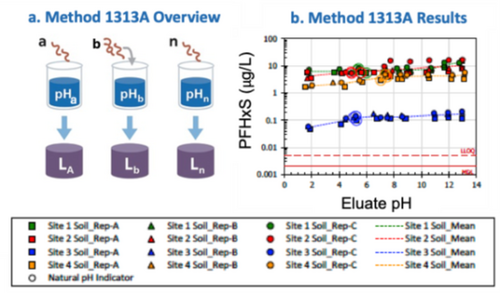
Figure 1: Figure 1. a) Overview of LEAF Method 1313A and b) PFHxS leaching as a function of pH
[1]. Definitions: lower limit of quantification (LLOQ) and method detection limit (MDL)
Draft Method 1313A was used to evaluate pH-dependent leaching in PFAS-contaminated soils in parallel batch extractions where each set of batch reactors is prepared and equilibrated at different pH (Figure 1). Short-chain PFAS (≤6 fluorinated carbons) generally showed little to no variation in leaching across the tested pH range of 2-13 (e.g., PFHxS, Figure 1), whereas long-chain PFAS exhibited increased leaching at higher pH[1]. This trend is consistent with previous findings showing that soil-water partitioning coefficients (Kd) decrease as pH increases (e.g., Higgins and Luthy 2006)[5]. The most pronounced pH effects were observed for perfluoroalkyl sulfonamides (FASAs) such as perfluorooctane sulfonamide (FOSA), which transition from neutral to anionic forms within the circumneutral pH range (~pH 6). The anionic form has a lower Kd and results in higher leaching concentrations[1][6]. For many site management scenarios where pH is circumneutral, variations in anionic PFAS leaching are expected to be small over the relevant pH range. In such cases, when testing time and costs are primary considerations, Method 1313A may be a lower priority relative to evaluating leaching as a function of L/S (Method 1316A, Method 1314A). Different considerations may be needed where FASAs or PFAS with multiple, ionizable functional groups (i.e., zwitterions) are of concern.
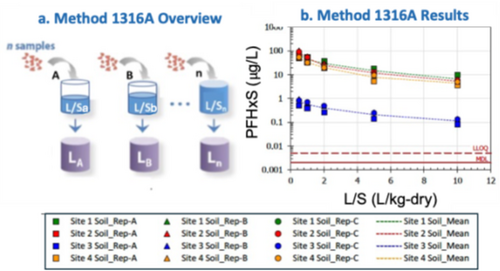
Figure 2: a) Overview of LEAF Method 1316A and b) PFHxS leaching as a function of L/S ratio evaluated in parallel batch leaching vessels
[1]Draft Method 1316A was used to evaluate L/S-dependent leaching of PFAS in impacted soils using parallel batch extractions where each set of batch reactors is prepared and equilibrated at a different L/S. (Figure 2). Methods 1314A and 1316A are similar in intent as they both evaluate leaching as a function of L/S; however, the experimental approach differs. Method 1314A uses a flow-through column configuration (Figure 3; discussed further below). Method 1314A may better simulate field conditions, but Method 1316A is simpler and less costly to implement. Trends in Method 1314A and 1316A are expected to be qualitatively similar but leaching concentrations are expected to exhibit differences. Despite this, leaching studies comparing Methods 1314A and 1316A for inorganics showed that cumulative release results were within one order of magnitude[7].
Method 1316A and Method 1314A may also provide different insights into transport mechanisms. Because Method 1316A is performed using equilibrated batch reactors at varying L/S, results can be used to develop equilibrium desorption isotherms and calculate desorption coefficients (e.g., Kd,desorption). Studies have shown that Kd,desorption values for PFAS may be greater than Kd, an effect often attributed to desorption hysteresis[8]. Consequently Method 1316A provides a straightforward method to estimate site-specific desorption parameters. Although sorption parameters can also be inferred from column (Method 1314A) data, interpretation is often complicated by nonequilibrium processes. Conversely, the column data can be valuable for quantifying those additional mechanisms providing transport parameters that can describe rate-limited transport (e.g., fraction of non-equilibrium sorption sites and sorption rates) and other dynamic behavior.
As anticipated, trends in PFAS leaching obtained during the Method 1316A and Method 1314A demonstrations were qualitatively similar. These are further discussed below.
Column Test Demonstration Studies
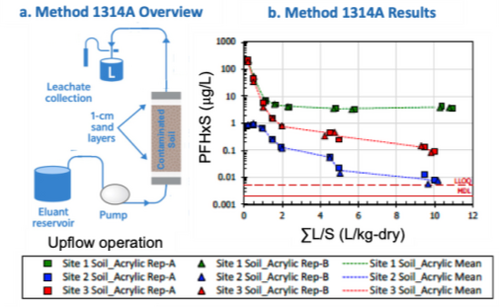
Figure 3. a) Overview of LEAF Method 1314A and b) PFHxS leaching as a function of ∑(L/S) evaluated in saturated up-flow column tests
[1]. Note that acrylic here simply refers to the column material of construction used in this round of Method 1314 testing.
PFAS-specific adaptations were tested in column test demonstration studies, which included triplicate implementation of Method 1314A in three AFFF-impacted site soils.
Draft Method 1314A was implemented in saturated, up-flow columns to evaluate leaching of PFAS as a function of cumulative L/S (∑(L/S)); Figure 3; total volume of water that has passed through the column divided by the soil mass in the column). As noted, the intent of Method 1314a and 1316a is similar, and in both tests, similar qualitative results were observed. For example, short-chain PFAS exhibited high initial concentrations that decreased rapidly. However, in Method 1314a, these rapid drops in short-chain PFAS tended to occur by ∑(L/S) ≈ 2 (e.g., Site 1 and 3 soils, Figure 3) whereas in some cases, such as for PFHxS, Method 1316A produced slightly flatter elution curves than Method 1314A (Figures 2b and 3b). Long-chain PFAS generally displayed flatter elution profiles than short-chain PFAS across both methods. These trends are consistent with chain length dependent sorption documented in the literature[5][6][9]. Although column modeling is beyond the scope of this article, prior studies have shown that saturated transport can be influenced by rate-limited desorption, particularly for long-chain PFAS[10][11]. As noted, data from Methods 1316A and 1314A can support estimation of transport parameters representing equilibrium and nonequilibrium behavior, respectively.
LEAF Screening Evaluations
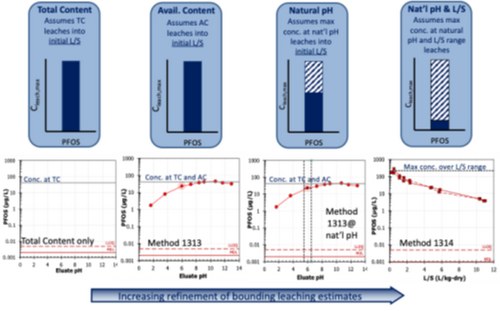
Figure 4. Example screening assessment for perfluorooctane sulfonate (PFOS) using total content and data from Methods 1313A and 1314A. Figure format adapted from Garrabrants
et al. 2021
[12].
LEAF provides a standardized, robust approach for evaluating PFAS release from impacted granular materials under a range of environmental conditions. The tests are complementary, capture a range of conditions, and vary in ease of implementation. This provides the flexibility for users to select the test or test combinations that best suit their project objectives, timeline, and budget. A common use of LEAF data is in screening level assessments. These are stepwise assessments that establish increasingly refined maximum leaching concentrations, Cleach,max (Figure 4), which can then be compared to regulatory limits such as maximum contaminant levels, when available. For example, a stepwise screening assessment might include:
- Assume the maximum leaching concentration is represented by the total content (total initial mass of contaminant present) leaching into the first L/S.
- Assume only the available content leaches into the first L/S where available content is the maximum mass released over pH 2-13 measured using Method 1313a. For many PFAS, total content is equal to available content meaning that all of the PFAS mass is available for leaching.
- Assume the leaching concentration at natural pH (measured in Method 1313A at natural pH or Method 1316A at L/S of 10) is maximum leaching concentration adjusted to the first L/S.
- Consider the maximum leaching concentration over the L/S range (Method 1314A or Method 1316A) and the upper estimate of leaching, or Cleach,max, is the concentration from either Step 3 or Step 4, whichever is greater.
Screening assessments may be sufficient to meet project goals, but when additional refinements of leaching estimates are needed, site-specific data (e.g., infiltration) can be combined with test data and computational approaches (e.g., fate and transport models) for more site-specific estimates of leaching. Example scenarios where LEAF may be used to evaluate PFAS-impacted solids include 1) estimating PFAS release from AFFF-impacted soils, 2) estimating PFAS release from biosolids-amended soils at land application sites, 3) providing transport parameters to model PFAS transport from the source zone to the saturated zone, and 4) evaluating PFAS release from treatment residuals such as soils or sediments treated by soil washing or thermal approaches.
Summary and Ongoing Research
The LEAF framework offers a reliable, replicable approach to evaluating PFAS release from solids. With recent adaptations for PFAS-specific considerations, LEAF methods provide valuable tools for regulators and practitioners in managing PFAS-contaminated materials and assessing long-term environmental risks. However, there are key areas of ongoing research, including:
- An interlab validation of Methods 1313A, 1314A, and 1316A in coordination with the EPA
- Optimization and demonstration of Method 1315A for use with PFAS-impacted solids
- Evaluation of an unsaturated Method 1314A protocol to assess the need for and ability of LEAF testing to capture air-water interfacial partitioning of PFAS
- Application of the total oxidizable precursor (TOP) assay for evaluating the maximum additional PFAS leaching that may occur as a result of polyfluoroalkyl precursor transformation
- Comparison of LEAF testing data to previously collected field-scale enhanced flushing data collected from the same site
Additionally, there are key areas for consideration in future research:
- Collection of paired field-laboratory data under ambient conditions to further validate the applicability of LEAF assessments for estimation of field-relevant PFAS leaching and mobility
- Consideration of biotransformation in modeling and interpretation of LEAF data, as the state of the science regarding biotransformation of polyfluoroalkyl substances to terminal perfluoroalkyl acids advances
Other LEAF Resources
There are numerous resources describing the development of the LEAF leaching methods for inorganics. They are not specific to PFAS, but are still valuable resources focused on LEAF implementation, applications, and management of LEAF data. They include:
References
- ^ 1.0 1.1 1.2 1.3 1.4 1.5 1.6 1.7 Garrabrants, A.C., Liu, F., Warne, R., DeLapp, R., Brown, L., Rubin, Z., Yawson, D., Kosson, D.S., Guelfo, J.L., Real, M.I., van der Sloot, H.A., Touati, A., Thorneloe, S., 2024. Development of Leaching Tests for Materials Containing SVOCs and PFAS, EPA 600/R-23/382, USEPA, Washington, D.C. Free Download EPA 600/R-23/382
- ^ Garrabrants, A.C., Kosson, D.S., Stefanski, L., DeLapp, R., Seignette, P.F.A.B., van der Sloot, H.A., Kariher, P., Baldwin, M., 2012. Interlaboratory Validation of the Leaching Environmental Assessment Framework (LEAF) Method 1313 and Method 1316, EPA/600/R-12/623, U.S. Environmental Protection Agency, Air Pollution and Control Division. Free Download EPA 600/R-12/623
- ^ Garrabrants, A.C., Kosson, D.S., DeLapp, R., Kariher, P., Seignette, P.F.A.B., van der Sloot, H.A., Stefanski, L., Baldwin, M., 2012. Interlaboratory Validation of the Leaching Environmental Assessment Framework (LEAF) Method 1314 and Method 1315, EPA/600/R-12/624, U.S. Environmental Protection Agency, Air Pollution and Control Division. Free Download EPA 600/R-12/624
- ^ USEPA, 2026. Hazardous Waste Test Methods / SW-846. USEPA SW-846 website
- ^ 5.0 5.1 Higgins, C.P., Luthy, R.G., 2006. Sorption of Perfluorinated Surfactants on Sediments. Environmental Science and Technology, 40(23), pp. 7251–7256. doi: 10.1021/es061000n
- ^ 6.0 6.1 Nguyen, T.M.H., Bräunig, J., Thompson, K., Thompson, J., Kabiri, S., Navarro, D.A., Kookana, R.S., Grimison, C., Barnes, C.M., Higgins, C.P., McLaughlin, M.J., Mueller, J.F., 2020. Influences of Chemical Properties, Soil Properties, and Solution pH on Soil–Water Partitioning Coefficients of Per- and Polyfluoroalkyl Substances (PFASs). Environmental Science and Technology, 54(24), pp. 15883–15892. doi: 10.1021/acs.est.0c05705 Open Access Article
- ^ Lopez Meza, S., Garrabrants, A.C., van der Sloot, H., Kosson, D.S., 2008. Comparison of the Release of Constituents from Granular Materials under Batch and Column Testing. Waste Management, 28(10), pp. 1853–1867. doi: 10.1016/j.wasman.2007.11.009
- ^ Schaefer, C.E., Nguyen, D., Christie, E., Shea, S., Higgins, C.P., Field, J., 2022. Desorption Isotherms for Poly- and Perfluoroalkyl Substances in Soil Collected from an Aqueous Film-Forming Foam Source Area. Journal of Environmental Engineering, 148(1), Article 04021074. doi: 10.1061/(ASCE)EE.1943-7870.0001952
- ^ Guelfo, J.L., Higgins, C.P., 2013. Subsurface Transport Potential of Perfluoroalkyl Acids at Aqueous Film-Forming Foam (AFFF)-Impacted Sites. Environmental Science and Technology, 47(9), pp. 4164–4171. doi: 10.1021/es3048043
- ^ Doria-Manzur, A., Gray, E.P., Streets, S.S., Guelfo, J.L., 2025. Per- and Polyfluoroalkyl Substances (PFAS) Transport from Biosolids-Amended Soils: An Experimental and Numerical Approach. Water Research, 288(Part B), Article 124674. doi: 10.1016/j.watres.2025.124674 Open Access Article
- ^ Guelfo, J.L., Wunsch, A., McCray, J., Stults, J.F., Higgins, C.P., 2020. Subsurface Transport Potential of Perfluoroalkyl Acids (PFAAs): Column Experiments and Modeling. Journal of Contaminant Hydrology, 233, Article 103661. doi: 10.1016/j.jconhyd.2020.103661 Open Access Manuscript
- ^ Garrabrants, A.C., Kosson, D.S., Brown, K.G., Fagnant, D.P., Helms, G., Thorneloe, S.A., 2021. Methodology for Scenario-Based Assessments and Demonstration of Treatment Effectiveness Using the Leaching Environmental Assessment Framework (LEAF). Journal of Hazardous Materials, 406, Article 124635. doi: 10.1016/j.jhazmat.2020.124635 Open Access Manuscript
See Also


